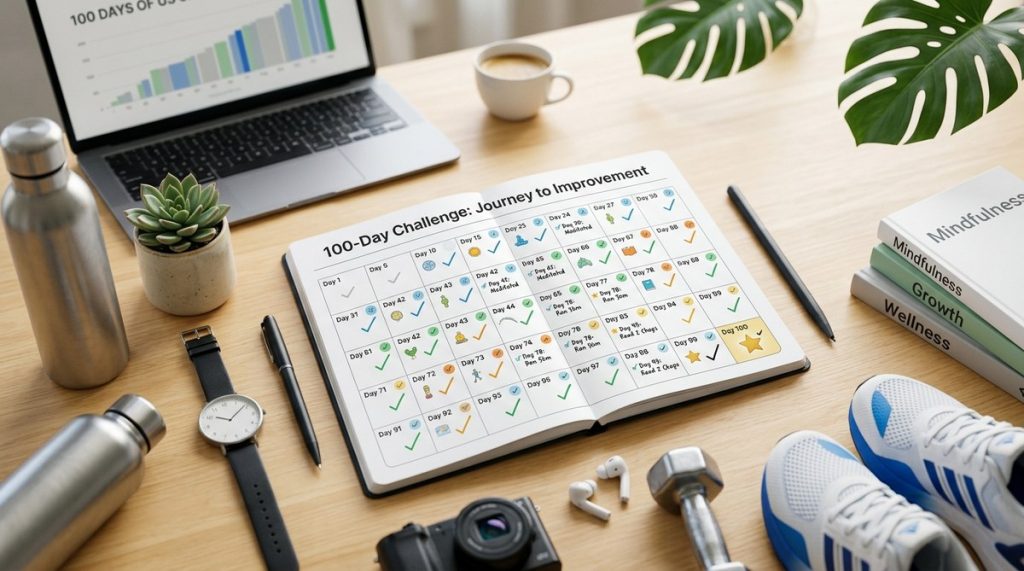
A 100 day challenge always begins with clarity. You choose one habit. You choose one start date. The idea feels manageable because the structure is simple. Problems appear later. Days blend together. You miss one session and suddenly feel behind. At that moment, most people do not fail because the habit is hard. They fail because time feels slippery. They cannot tell where they stand anymore.
That is why clear time math matters. When you know exactly how long ago you started and exactly how long remains, uncertainty disappears. A question like Day 37 how long ago did you start stops being emotional and becomes factual. A tool such as time from now makes that clarity instant and removes guesswork from the process.
Quick Summary
A 100 day challenge works best when time is visible. Tracking start dates, rest days, and milestones with simple math keeps momentum steady and removes guilt from the process.
Why time clarity keeps challenges from fading
When people abandon a challenge, they often say life got busy. What they usually mean is that the challenge stopped feeling concrete. Without clear markers, effort feels disconnected from progress. Time awareness fixes this by creating a visible arc from day one to day one hundred.
Instead of relying on motivation, you rely on dates. You know when you began. You know how many days you have completed. You know how many remain. This turns a vague goal into a finite project. Finite projects are easier to finish.
Long form challenges such as daily life transformation goals succeed because they frame progress as accumulation. Each day adds weight. Time becomes an ally rather than an enemy.
Understanding streaks without pressure
Streaks are powerful because they show consistency. Problems start when streaks become judgment. A broken streak can feel like failure even when dozens of days were completed before it. This mindset pushes people to quit entirely.
A healthier approach treats streaks as data points. A streak tells you how often you showed up in a row. It does not erase what came before. If you completed thirty seven days, that effort remains real even if you paused.
Tracking streaks works best when paired with dates. Knowing the last day you completed the habit is more useful than knowing you missed yesterday. Dates give you context. Context reduces emotional reactions.
Rest days as part of the system
Rest days are often misunderstood. Many people believe a 100 day challenge requires perfect daily execution. In reality, rest days protect long term consistency. They prevent burnout and allow recovery.
Physical challenges highlight this clearly. Programs such as structured fitness routines include lighter days for a reason. Muscles adapt during rest. Motivation works the same way.
The key difference between a rest day and a skipped day is intention. A rest day is planned. It has a reason. It is recorded. When rest is intentional, it does not break momentum. It supports it.
Simple time math that anyone can use
You do not need complex tracking systems. You only need three reference points. Your start date. Today’s date. Your planned end date. With those three, everything else becomes easy to calculate.
- Count days completed by calculating the time between your start date and today.
- Count days remaining by calculating the time between today and your day one hundred date.
- Decide how many rest days you can afford within that remaining window.
This simple structure gives you control. If you see that you have used many rest days early, you adjust later. If you see that you are ahead, you can slow down without guilt.
Why milestones make the middle manageable
The middle of a 100 day challenge is where most people struggle. The novelty is gone. The finish feels far away. Without milestones, effort feels endless.
Milestones break the journey into sections. They give you short finish lines inside the larger one. Each milestone reinforces identity. You are no longer trying a challenge. You are someone who follows through.
| Milestone | Meaning | Focus |
|---|---|---|
| Day 10 | Habit initiated | Protect consistency |
| Day 25 | Pattern forming | Refine your process |
| Day 50 | Identity shift | Recommit intentionally |
| Day 75 | Finish in sight | Reduce friction |
Different challenges need different pacing
Not all 100 day challenges demand the same energy. Creative challenges reward flexibility. Skill based challenges reward repetition. Understanding this helps you choose realistic pacing.
Creative formats such as daily drawing practice often succeed when expectations are light. Some days produce detailed work. Other days produce simple marks. Both count toward continuity.
Learning based challenges benefit from rhythm. Short daily sessions work better than occasional long ones. Time math helps you see whether your rhythm is sustainable.
Tracking progress without obsession
Tracking should support action, not replace it. A single daily check is enough. You confirm your day count. You confirm your next milestone. Then you focus on doing the work.
Avoid checking progress multiple times a day. That turns tracking into anxiety. The purpose of time math is reassurance. It reminds you that progress accumulates quietly.
What finishing actually changes
Completing a 100 day challenge rarely feels dramatic. The real change shows up later. You notice the habit persists. You notice confidence grows. You trust yourself more because you have evidence.
Behavior research summarized by health behavior studies shows that repetition over time reshapes automatic behavior. One hundred days works because time does the shaping gradually.
Keeping your timeline visible until the end
The most reliable challenges use simple systems. A visible start date. A visible end date. Occasional milestone checks. This structure reduces decision fatigue and keeps focus on action.
When doubt appears, return to the numbers. Count backward to remember how far you have come. Count forward to see how close the finish is. Then take the next small step. That step is always enough.