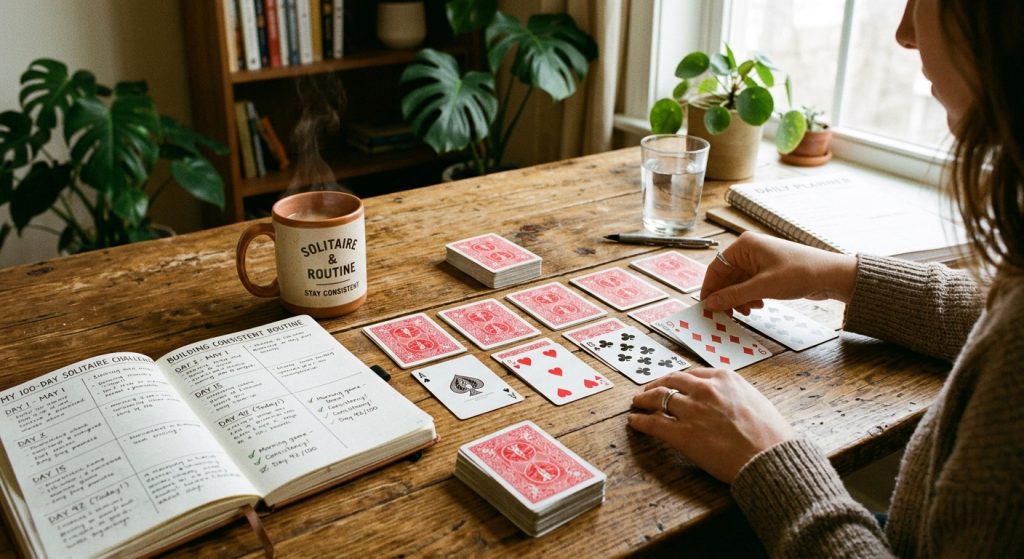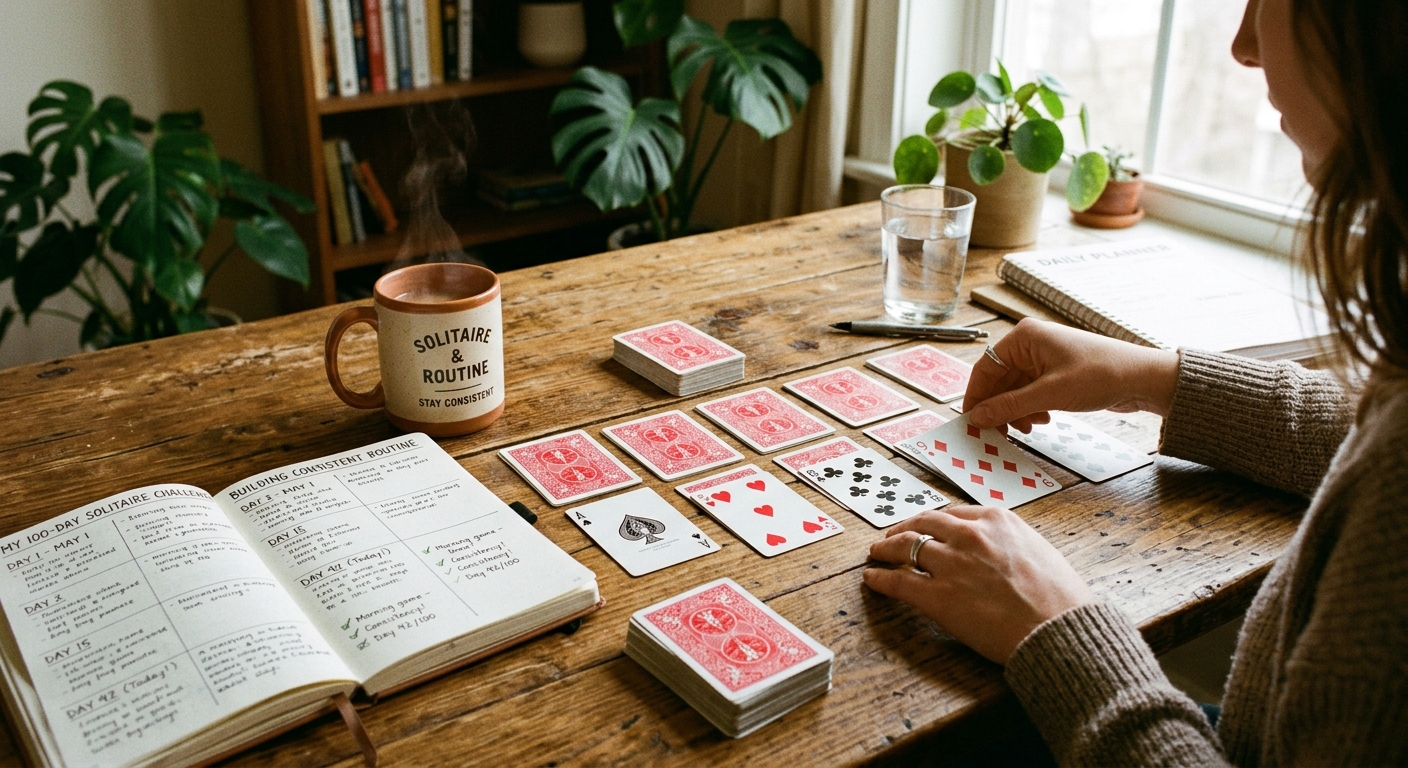
A 100-Day Solitaire Challenge to Build a More Consistent Daily Routine
Your coffee is cooling. Your phone is already asking for attention. The day has barely started, yet the small promise you made to yourself is slipping down the list. What if that promise took just five minutes and began with a deck of cards?
A 100-day solitaire challenge gives you one small action to return to each day. You choose a time, play for a few minutes, and record that you showed up. Winning is welcome, but participation is the goal. The useful practice is making room for a manageable commitment, even when your schedule feels crowded.
Your Five-Minute Game Plan
- Choose one daily cue and a backup time.
- Keep each session within five minutes.
- Track participation instead of wins.
- Write one brief reflection after playing.
- Return after missed days without restarting.
Make Showing Up the Rule That Counts
Before day one, define what you are trying to do. This challenge is a chance to practice keeping a small appointment with yourself. You do not need a winning streak, a high score, or enough free time to finish every deal.
Use this rule: a completed session means you opened a game, gave it your attention, and recorded your participation. Your five-minute window includes a brief reflection at the end. An unfinished game still counts.
That distinction matters on an ordinary Tuesday. You might get stuck after several moves. You might spend most of your time thinking through one choice. Neither outcome cancels the session. You did the action you planned to do.
Give the challenge a clear boundary, too. Run it for 100 calendar days. Record any gaps honestly, then continue toward your original finish date. This makes the challenge easy to understand without turning one missed evening into a reason to abandon it.
Choose a Time You Can Recognize
“I will play sometime today” leaves you with another decision to make. Choose a moment you can recognize instead. Your cue might be finishing breakfast, putting away your lunch dishes, or closing your work laptop.
Connect the session to something that already happens. For example: “After I put my breakfast plate in the sink, I will sit down for five minutes of solitaire.” That sentence tells you when to begin and what to do.
Pick a time that fits your actual life. An early session may suit someone with unpredictable evenings. An after-dinner session may suit someone whose mornings involve school bags and a crowded kitchen. Neither choice earns extra credit.
Set one backup window before you need it. If breakfast gets rushed, perhaps you play after lunch. A backup gives a disrupted day another opening. Keep it specific enough that you will recognize it when it arrives.
Prepare a Small Place to Begin
You do not need a special setup. Use a chair, a clear corner of a desk, or another comfortable spot. Keep your game easy to reach and your tracker nearby. If you use your phone, silence notifications during the session when practical.
The goal is to reduce the number of steps between your cue and your first move. A ritual that requires clearing a room or finding a missing notebook may feel much larger than five minutes.
Give the Five Minutes a Simple Shape
Start your timer when you sit down. Take a breath, open your game, and begin. Let most of the session belong to playing. Save the final few moments for a mark on your tracker and a short note.
When the timer ends, stop at the next convenient moment. You may leave a promising game unfinished. That can feel odd at first, especially when you think one more move might solve it. Ending on time helps keep tomorrow’s commitment believable.
If you enjoy longer games, you can play again later. Keep the challenge itself bounded. You should be able to look at tomorrow’s calendar and know exactly how much time you have promised.
On an unusually difficult day, use a minimum version: open the game, make a deliberate move, and log a shortened session. Mark it differently from a full session. This keeps your record honest while giving you a small way to participate.
Let a Daily Puzzle Handle the Starting Point
Choosing what to play can become an unnecessary delay. A daily solitaire challenge offers a ready-made daily puzzle, giving your session a clear starting point. Sit down at your chosen time and work with the cards in front of you.
If you are new to solitaire, spend your first session reading the available instructions. Learn what counts as a legal move and what the game asks you to build. You can learn through play without expecting yourself to spot every useful move immediately.
During each session, notice one decision. Did you pause before moving a card? Did you rush because the timer was running? Did a blocked position tempt you to quit? These observations give you something to reflect on whether the game ends in a win or remains unfinished.
A win can be satisfying. An awkward session can still fulfill your commitment. Keep asking the question that fits this challenge: “Did I make time to show up and pay attention?”
Track Participation Without Creating More Work
Your tracker should take seconds to update. A calendar, a notebook page, or a simple note on your phone is enough. Write the start and finish dates somewhere visible, then give each day a small space.
Use marks you can understand at a glance. Avoid a scoring system that requires calculations or a long explanation. You are keeping a record of what happened.
- Full session: Mark a check when you complete your planned five-minute ritual.
- Shortened session: Mark an S when you use your minimum version.
- Missed session: Mark an X when you do not participate.
- Brief reflection: Add a few words about your attention, timing, or mood.
Your note might say, “Started late, glad I sat down.” Another day, it might read, “Kept checking messages.” Both are useful records. Neither needs a paragraph of explanation.
Keep wins separate if you want to record them. Give participation the most visible space. Otherwise, an enjoyable side detail can quietly become the standard you use to judge the entire challenge.
Return After a Missed Day Without Adding Debt
At some point, you may forget. Travel may change your schedule. You may reach bedtime and realize you never sat down. Decide how to respond now, while the answer is easy.
Mark the missed day and return at your next planned cue. Keep your original day count. Day 28 follows day 27, even if day 27 contains an X.
Skip catch-up sessions. Playing for fifteen minutes after three missed days does not recreate those daily appointments. It also makes returning more demanding. Your next step is simply the next five-minute session.
If gaps keep appearing, look for a practical cause. Perhaps your chosen cue happens while you are commuting. Perhaps your evenings are less predictable than you expected. Adjust the time or setting, then try again.
You can hold yourself accountable without making the response unpleasant. An honest record and a workable adjustment give you something useful to do next.
Move Through 100 Days With Small Adjustments
The challenge can stay simple while your approach becomes more informed. Use a few checkpoints to notice what is helping and what needs changing.
Days 1 to 10: Make Starting Familiar
Focus on finding your cue, opening the game, and logging the session. Read the rules again if needed. Leave scores and playing speed alone. These early days are for learning what the ritual feels like in your schedule.
Days 11 to 30: Check the Timing
Look at when you actually played. If you keep using your backup window, consider making it your main time. Let your record guide that choice. A plan that fits your day is easier to follow than one chosen because it sounded impressive.
Days 31 to 60: Keep the Commitment Small
You may feel tempted to increase the daily requirement. Pause before doing that. Five minutes remains enough for this challenge. Use this stretch to practice returning during busy weeks and stopping when your planned time ends.
Days 61 to 100: Notice What You Can Repeat
Review your notes occasionally. Look for the conditions that made starting easier. Maybe leaving your tracker open helped. Maybe playing before opening messages gave the session a clearer place in your morning. Keep the details you could use again.
Use Reflection to Learn From Ordinary Sessions
You do not need a new insight every day. A brief observation is enough. Choose one prompt when you are unsure what to write.
- What helped me begin today?
- When did my attention drift?
- How did I respond when I got stuck?
- What would make tomorrow’s session easier?
Keep your answers concrete. “Put the tracker beside my mug” gives you a usable next step. “Be more disciplined” leaves you with a judgment and no clear action.
You may also find that some sessions feel pleasant and others feel routine. Let both count. You made a commitment to participate, and your record can reflect the full range of ordinary days.
Leave Day 100 With a Routine You Understand
On day 100, play your session and make your final mark. Then spend a few minutes looking back. Count full sessions, shortened sessions, and missed days separately. Read a handful of notes from the beginning, middle, and end.
Ask what you learned about choosing a time, protecting five minutes, and returning after a gap. Those answers are more useful than a perfect-looking calendar.
Choose your next step deliberately. You might keep the solitaire ritual, finish it there, or use the same cue for another small practice. The challenge has given you a record of what you could repeat in real life.
Your next consistent routine can begin with that knowledge: a clear starting point, a manageable action, and a way to return when a day gets missed.