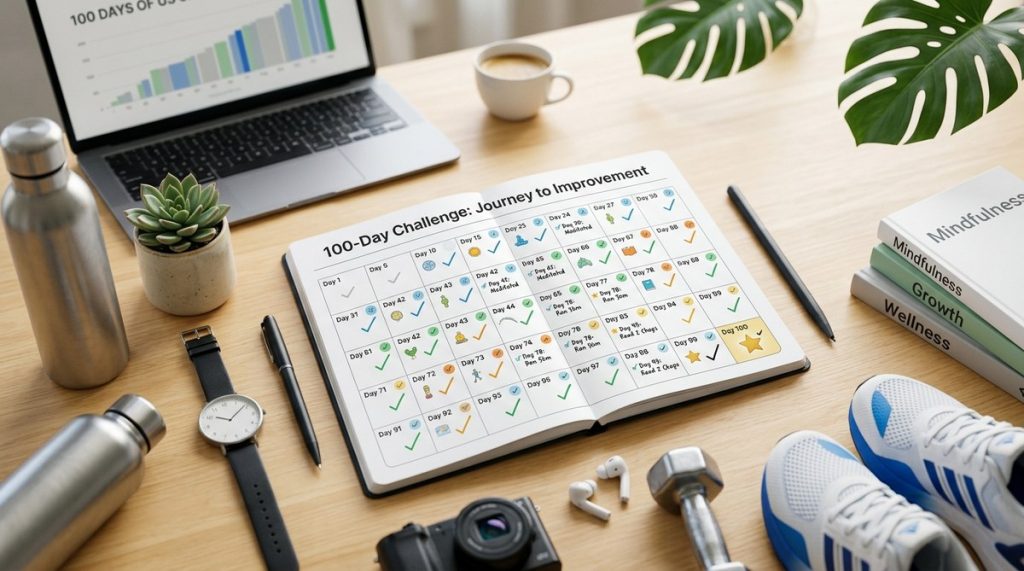
The Case for Planning Your 100-Day Challenge With Pen and Paper
Your phone already has a dozen apps that promise to track your 100-day challenge. And yet, person after person who actually finishes one will tell you the same thing: they used a piece of paper. Not an app. Not a spreadsheet. A piece of paper, a pen, and sometimes a little tape on the wall. There is something about physically writing down a plan that apps just cannot replicate. This article makes the case for why, and shows you exactly how to set yours up before day one.
The Core Case for Paper Planning
- Writing by hand signals commitment to your brain in a way that typing cannot.
- A physical calendar shows all 100 days at once, keeping the full scope permanently in view.
- Crossing off days by hand creates a satisfying, tactile sense of real progress.
- Paper lives in your space, unlike an app you have to remember to open.
- Personalizing your system builds emotional ownership that keeps you going longer.
Why Apps Often Undermine Long Challenges
Apps are built for short attention spans. A two-week habit tracker? An app handles that beautifully. But 100 days is roughly three and a half months of daily commitment. That is a fundamentally different challenge, and apps have a few quiet ways of working against you.
They hide the scale. An app shows you today. Maybe this week. But 100 days is a long runway, and most apps compress it into a progress bar or a counter. You never really feel the weight of what you have signed up for, which makes it easy to underestimate how much resolve the challenge actually requires.
Apps also compete for your attention in a very crowded place. Your phone is full of notifications, feeds, and distractions. Your challenge app becomes just another icon. Out of sight, out of mind is not just a saying. It describes exactly what happens to most digital tracking systems by week three.
The friction to quit is also dangerously low. Deleting an app takes two seconds. Throwing away a paper calendar you have worked on for 40 days? That feels genuinely painful. That friction is actually a feature. It is the kind of resistance that keeps you anchored when motivation dips.
The Science Behind Writing Things Down
The pen-and-paper advantage is not just intuition. Research on handwriting versus typing consistently shows that physically writing something forces your brain to process information more deeply. When you write, you are not just recording. You are encoding.
A widely cited study on handwriting and memory retention found that people who take notes by hand understand and retain information better than those who type the same content. The physical act of forming letters slows you down just enough to engage more fully with what you are writing.
That depth of processing matters enormously for goal-setting. Commitment is not just a feeling. It is a cognitive state. When you write out your 100-day plan, your brain treats it more like a promise than a passing thought. That encoded sense of ownership is exactly what you want on day one.
Setting Up Your Paper System Before Day One
The best time to build your paper planning system is before your challenge starts. Not on day one. Before it. Give yourself an evening to lay everything out properly. Starting with a clear, complete setup makes a meaningful difference to how you feel at the very start and throughout the weeks that follow.
The Calendar Is Your Foundation
The most important piece of your setup is a full 100-day view. You need to see all 100 days at once, not just one week at a time. Print a blank calendar and use it as your master map. Write the start date in the first box, then number every single day through to day 100. This takes about ten minutes and is one of the highest-value steps in your entire setup.
Pin it somewhere you will see it every single day. Not in a notebook drawer. Not tucked in a folder. On the wall beside your desk. On the fridge. On the inside of a cabinet you open every morning. The whole point is visibility. An unseen plan is not a plan at all.
A Simple Ritual for Marking Off Completed Days
The act of crossing off a completed day matters more than it might seem. It is a tiny moment of victory, repeated 100 times. Here is a straightforward way to build that ritual into your system:
- Keep a specific pen beside your calendar that you use only for marking off days.
- At the end of each day, draw a clear X or checkmark through the completed box.
- Pause for a moment and look at the growing row of marks building behind you.
- If you miss a day, write a brief note in that box rather than leaving it blank and moving on.
- At every ten-day milestone, add something extra: a circle, a star, a sticker. Make those moments visually distinct.
That sequence sounds almost too simple. That is the point. Simple rituals last. Complicated systems collapse.
Building Beyond the Calendar
A single calendar is your backbone. Your paper system can grow from there, but it should grow slowly and only if each addition genuinely helps you.
A plain notebook works well alongside the main calendar. One page per week is usually enough. At the start of each week, jot down your intention for the next seven days, any obstacles you are already anticipating, and one backup plan for when motivation slips. Keep these notes short. A few sentences per week. The goal is reflection, not lengthy journaling.
Some people also keep a small progress column for tracking time spent on the challenge each day. Others add a mood marker beside each completed box. Whatever you add, keep it lightweight. The moment maintaining your paper system starts to feel like work, it becomes a liability instead of an asset.
Personalizing a System That Feels Like Yours
This is where paper genuinely outperforms any app. You can make it yours in ways that no digital tool allows.
- Use colored pens to distinguish between types of days, such as rest days, intensive days, or review days.
- Write a motivational line at the top of your calendar in your own handwriting before you begin.
- Add a small reflection box beside each week for a single sentence about how that stretch felt.
- Mark milestones at days 25, 50, 75, and 100 with something visually distinctive before the challenge even starts.
- Attach a photo, a sticky note, or a symbol that connects directly to why you started.
None of these additions are required. But the ones you choose become yours. That sense of ownership is harder to build with a template app. When your calendar carries your handwriting, your colors, your notes in the margins, abandoning it starts to feel like abandoning something personal. That emotional weight is a genuine asset for a 100-day commitment.
Reader Stories: What Worked on the Wall
People who have used physical planning for their 100-day challenges often describe a similar turning point. Around day 20 or 30, they walk past the calendar on their wall and see the growing line of checkmarks. Something shifts. The challenge starts to feel inevitable rather than uncertain. That feeling is hard to manufacture artificially. It tends to emerge naturally when progress is physically visible every single day.
One person doing a 100-day writing challenge taped her calendar to the back of her bedroom door so it was the first thing she saw each morning. By day 50, she said looking at it felt less like checking in and more like greeting something familiar and real. She finished on day 100.
Another person doing a daily exercise challenge printed his calendar at double size and added tiny hand-drawn illustrations in each completed box. Stick figures doing jumping jacks. Mini running shoes. He said it sounds silly in retrospect, but that it kept him more emotionally engaged with the goal than any fitness app ever had. He also finished.
The thread running through every story like this is not a perfect system. It is the physical presence of the plan, in the room, on the wall, in their handwriting. The plan felt real because they could see it. Every single day.
What Happens When You Fall Behind
No paper system is magic against a rough week. Life gets complicated. You miss a day. Maybe two.
Paper handles this better than apps do. When you miss a day in an app, the streak counter resets and the whole interface tends to feel like an accusation. Many people quit at that moment. With paper, a missed day is just a blank box in a field of checkmarks. It does not erase what came before. Write a note in that box if you want, or just leave it and keep going. The rest of the calendar is still there, still waiting, full of uncrossed days that want your attention.
A paper system keeps the focus on overall progress rather than on the streak. That distinction matters enormously over 100 days.
What the Calendar on Your Wall Already Knows
Before day one, take real time to set this up. Print your calendar. Write in your dates. Choose your marking pen. Pick your spot on the wall. Spend 20 minutes making the setup feel intentional rather than rushed. That investment pays forward across all 100 days.
There is a reason people have been writing plans on paper for a very long time. Digital tools are powerful, but they have not replaced the clarity that comes from holding a pen, looking at a blank page, and deciding to fill it with something that actually matters to you.
That is what a 100-day challenge deserves. Not a counter on a screen. Not a push notification. A real, physical, handwritten plan that lives in your space and reminds you every single day that you made a decision, and that you are keeping it.